

Course Introduction
Our school has entrance courses and private education courses. The entrance courses are courses aimed at entering Japanese vocational schools, universities and graduate students. The private teaching class can freely adjust the class time according to the requirements of the students.
| Course | Enrollment Period | Number of Classes | Class Hours |
| College Preparation Course (2 Years) | April Enrollment | XXX school days, XXXX class periods |
Morning: 9:00 – 12:20 Afternoon: 13:30 – 16:50 |
| College Preparation Course (1.5 Years) | October Enrollment | XXX school days, XXXX class periods |
※ The school will decide whether students are assigned to the morning or afternoon class.


1 Year and 6 Month Preparatory course
Build a strong foundation from the beginner level and advance to higher levels in a short time.
Study Plan
| Level (JLPT) | Subjects (Class Hours) | Course Content | Study Period |
|---|---|---|---|
| Level 1 (N5) | Elementary Japanese 1 200 hours / 3 months | Comprehensive Japanese (Vocabulary, Grammar, Writing, etc.) Conversation | First Year October–December |
| Level 2 (N4) | Elementary Japanese 2 200 hours / 3 months | Comprehensive Japanese (Vocabulary, Grammar, Writing, etc.) Conversation | First Year January–March |
| Level 3 (N3) | Pre-Intermediate Japanese 400 hours / 6 months | Comprehensive Japanese JLPT Preparation, Conversation | First Year April–September |
| Level 4 (N2 – First Term) | Intermediate Japanese 1 200 hours / 3 months | Comprehensive Japanese JLPT Preparation, JLPT Mock Tests | Second Year October–December |
| Level 5 (N2 – Second Term) | Intermediate Japanese 2 200 hours / 3 months | Comprehensive Japanese JLPT Preparation, JLPT Exam Practice | Second Year January–March |
※ Depending on individual academic performance and learning progress, placement in a higher-level class may be possible.
Admission Period: Every April
Class Hours: 5 days per week (Monday–Friday)
Morning Class: 9:00–12:20
Afternoon Class: 13:30–16:50
(4 periods × 45 minutes per day for both morning and afternoon classes)
Admission Requirements:
1. Applicants must be 18 years or older and have completed 12 years of formal school education in their home country or region.
2. Applicants must have Japanese language proficiency equivalent to JLPT N5 or higher, or have completed at least 150 hours of Japanese language study.
* However, this requirement does not apply to applicants who have graduated from a four-year university (or higher) in their home country.
Study Plan
| Level (JLPT) | Course (Class Hours) | Course Content | Study Period |
|---|---|---|---|
| Level 1 (N5) | Elementary Japanese I 200 hours / 3 months | Comprehensive Japanese (Vocabulary, Grammar, Writing, etc.) Conversation | First Year April – June |
| Level 2 (N4) | Elementary Japanese II 200 hours / 3 months | Comprehensive Japanese (Vocabulary, Grammar, Writing, etc.) Conversation | First Year July – September |
| Level 3 (N3) | Pre-Intermediate Japanese 400 hours / 6 months | Comprehensive Japanese, JLPT Preparation, EJU Preparation, Conversation | First Year October – March |
| Level 4 (N2 – First Term) | Intermediate Japanese I 200 hours / 3 months | Comprehensive Japanese, JLPT Preparation, EJU Preparation, EJU (Science & Humanities) Preparation | Second Year April – June |
| Level 5 (N2 – Second Term) | Intermediate Japanese II 200 hours / 3 months | Comprehensive Japanese, JLPT Preparation, EJU Preparation, EJU (Science & Humanities) Preparation | Second Year July – September |
| Level 6 (N1 – First Term) | Advanced Japanese I 200 hours / 3 months | Comprehensive Japanese, JLPT Preparation, EJU Preparation, EJU (Science & Humanities) Preparation | Second Year October – December |
| Level 7 (N1 – Second Term) | Advanced Japanese II 200 hours / 3 months | Comprehensive Japanese, Academic Japanese, Conversation | Second Year January – March |
※ Depending on individual academic performance and learning proficiency, students may also be placed in a higher-level class.
Curriculum
Goals
(2) While using Japanese, students develop the ability to think independently and actively tackle challenges.
(3) Students deepen their understanding of society and culture and become able to take initiative with curiosity and a spirit of inquiry.
Class Format
Our classes emphasize a communication-centered learning environment where instructors and students actively engage with one another. Through activities such as role-plays, pair work, group projects, discussions, and presentations, students learn collaboratively and work together to solve tasks. We also foster initiative and intellectual curiosity while deepening students’ understanding of Japanese society and culture.
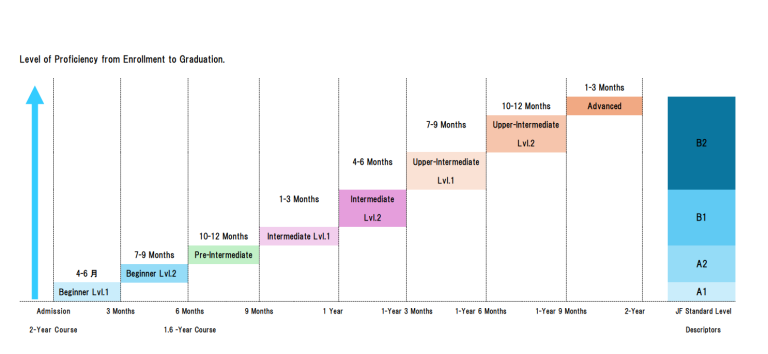
2 Year Course Goals
| Main Target | Students whose Japanese proficiency at the time of admission is equivalent to A1 level and who aim to advance to vocational schools in Japan. |
|---|---|
| Program Goals | Students will be able to understand the main points of complex texts covering both concrete and abstract topics, including discussions related to their desired field of specialization. They will also be able to generally understand television news and current affairs programs. Furthermore, they will be able to interact fluently and naturally with proficient Japanese speakers without excessive tension. In addition, they will be able to give oral presentations on topics related to their field of interest. |
Based on the Japanese-Language Education Reference Framework, the goal is to achieve B2 level proficiency in all language activities: Listening, Reading, Speaking (Interaction), Speaking (Presentation), and Writing.
1 Year 6 Months Course Goals
| Main Target | Students whose Japanese proficiency at the time of admission is equivalent to A2 level and who aim to advance to vocational schools in Japan. |
|---|---|
| Program Goals | Students will be able to listen to and read texts dealing with social and cultural topics and fully understand their content. Regarding their intended field of specialization or topics commonly discussed in society, they will be able to present reasons for or against a particular viewpoint with supporting evidence, and explain multiple options along with the disadvantages of each. Furthermore, they will be able to logically express their own opinions, with awareness of discourse structure, on themes related to their areas of interest. |
Based on the Japanese-Language Education Reference Framework, the goal is to achieve B2 level proficiency in all language activities: Listening, Reading, Speaking (Interaction), Speaking (Presentation), and Writing.
Timetable
This class schedule is an example designed to ensure that students can progress in their Japanese studies smoothly according to their level. Centered on comprehensive Japanese, it combines classes such as reading and listening to help students develop practical Japanese language skills.
| 2 Year Course Upper-Intermediate Level 1 Class (AM)Example |
Mon | Tue | Wed | Thu | Fri | |
|---|---|---|---|---|---|---|
| Period 1 | 9:00 ~ 9:45 | General Japanese | General Japanese | General Japanese | Listening | General Japanese |
| Period 2 | 9:45 ~ 10:30 | General Japanese | General Japanese | General Japanese | Listening | General Japanese |
| Period 3 | 10:50 ~ 11:35 | Reading | Exam Preparation | Exam Preparation | Writing | Characters & Writing |
| Period 4 | 11:35 ~ 12:20 | Reading | Exam Preparation | Exam Preparation | Writing | Speaking |
| 1 Year and 6 Months Course Beginner Level 1 Class(PM) Example |
Mon | Tue | Wed | Thu | Fri | |
|---|---|---|---|---|---|---|
| Period 1 | 13:30 ~ 14:15 | General Japanese | General Japanese | General Japanese | General Japanese | General Japanese |
| Period 2 | 14:15 ~ 15:00 | General Japanese | General Japanese | General Japanese | General Japanese | General Japanese |
| Period 3 | 15:20 ~ 16:05 | General Japanese | General Japanese | Reading | Listening | General Japanese |
| Period 4 | 16:05 ~ 16:50 | General Japanese | Characters & Writing | Reading | Characters & Writing | General Japanese |
※There is a possibility of change.
Annual Schedule
The annual schedule is designed to help students balance Japanese language study and student life. Through regular examinations and individual counseling sessions, we monitor academic progress and future goals. In addition, we offer extracurricular activities such as Japanese cultural experiences and community exchange programs to support students in enjoying a fulfilling and enriching student life.
| Month | Events | Extracurricular Activities |
|---|---|---|
| April | Spring Entrance Ceremony / Health Check | Orientation / Daily Life Guidance |
| May | Individual Interviews | Japanese Lifestyle & Manners Seminar |
| June | JLPT Mock Examination | Itoman Hare (Traditional Boat Race Festival) |
| July | First Japanese-Language Proficiency Test (JLPT) | Japanese Cultural Experience (Calligraphy) |
| August | Individual Interviews / Further Education Survey | Beach Party |
| September | Regular Examinations | Disaster Prevention Drill / Community Clean-Up |
| October | Autumn Entrance Ceremony / Health Check | Itoman Great Tug-of-War Festival |
| November | JLPT Mock Examination | Higher Education Guidance Session / School Visits |
| December | Second Japanese-Language Proficiency Test (JLPT) | Year-End Party |
| January | Career Survey / Pre-Completion Guidance | Individual Employment / Further Education Counseling |
| February | Extracurricular Presentations | Cherry Blossom Viewing / Excursion |
| March | Graduation Ceremony | Completion Commemorative Event |